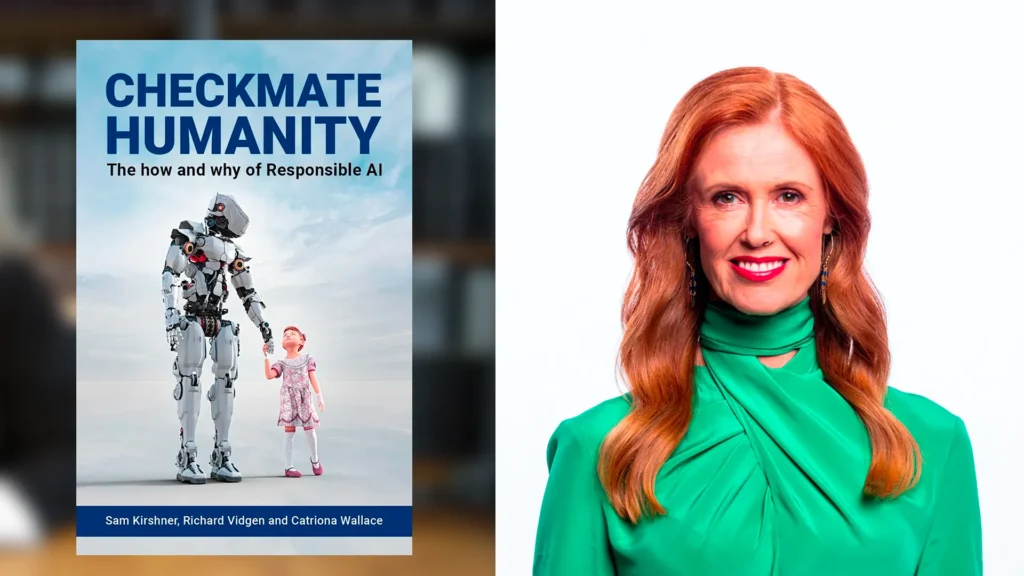
By Sam Kirshner, Richard Vidgen & Catriona Wallace (with additional contributors)
Let’s be honest — most books about AI fall into one of two camps. Either they’re breathless cheerleading about how robots are going to fix everything, or they’re full-on doom-and-gloom apocalypse narratives that leave you wanting to move to a cabin in the woods with no Wi-Fi. Checkmate Humanity is refreshingly neither. It’s a serious, well-researched, and genuinely accessible guide to one of the most important questions of our time: can we build AI that actually works for us rather than against us?
The title, of course, is a nod to the idea that AI systems are increasingly able to out-think, out-negotiate, and out-manoeuvre humans — and the authors aren’t being subtle about the stakes. As Louis Rosenberg, CEO of Unanimous AI, puts it, AI systems are learning to master the game of humans, and there’s a notable lack of urgency, especially in industry, about putting proper safeguards in place. Issuu That urgency is exactly what this book is trying to create, and to its credit, it largely succeeds.
The book brings together nine internationally-renowned AI academics, researchers, and entrepreneurs to explore the AI terrain, outline the potential dangers of unconstrained AI development, and propose practical guidance for the road ahead. Dr Catriona Wallace That’s a big team, and with books like this there’s always the risk it ends up feeling like a committee report. Somehow, though, it holds together — and a lot of that cohesion comes from the clarity of its central mission. Checkmate Humanity maps the potential harms that AI may cause, from individual harms right through to full existential risk, and introduces what the authors claim is the world’s first taxonomy of AI harms. Amazon Whether or not you buy that particular claim, the framework they present is genuinely useful — it gives readers a vocabulary and a structure for thinking about AI risk that most of us simply don’t have.
Ed Santow, Industry Professor in Responsible Technology at UTS and a former Australian Human Rights Commissioner, describes it as offering a firm foundation of scientific fact applied to a range of threats and opportunities, leaving readers better armed to face a world being fundamentally reshaped by AI. Dr Catriona Wallace That’s a pretty solid endorsement, and it’s well-earned. The book doesn’t talk down to you, but it also doesn’t assume you have a computer science degree.
Now, a special word about Catriona Wallace, because she really is a standout presence here. Wallace is widely acknowledged as a top global commentator on AI and the Metaverse, and the Australian Financial Review regards her as the most influential woman in business and entrepreneurship in Australia. Dr Catriona Wallace With a PhD in Organisational Behaviour focused on the relationship between technology and human behaviour, her academic background gives her a deep grounding in how AI intersects with real people and real organisations. Dr Catriona Wallace What sets Wallace apart is that she’s not just a theorist — she’s known for boldly calling out the realities of technology and ethics, advising governments and businesses across the globe on responsible technology. Issuu That practitioner’s edge comes through in the book. Her sections feel lived-in and urgent, not just academically neat.
Reader responses back this up. Fans have described the book as a one-stop-shop bible for AI, covering content from the theoretical to the practical, with great visuals to boot. LinkedIn One reader mentioned they keep returning to it as their go-to reference — which is probably the best thing you can say about a non-fiction book in a field moving this fast.
If you’ve ever wondered what “responsible AI” actually means in practice, or if you’ve been vaguely worried about where all this technology is heading and wanted something more rigorous than a think-piece, Checkmate Humanity is well worth your time. It’s not light reading, but it’s not impenetrable either. Think of it as the book you’d want your boss, your government, and your AI developer to all read before they make any more big decisions.