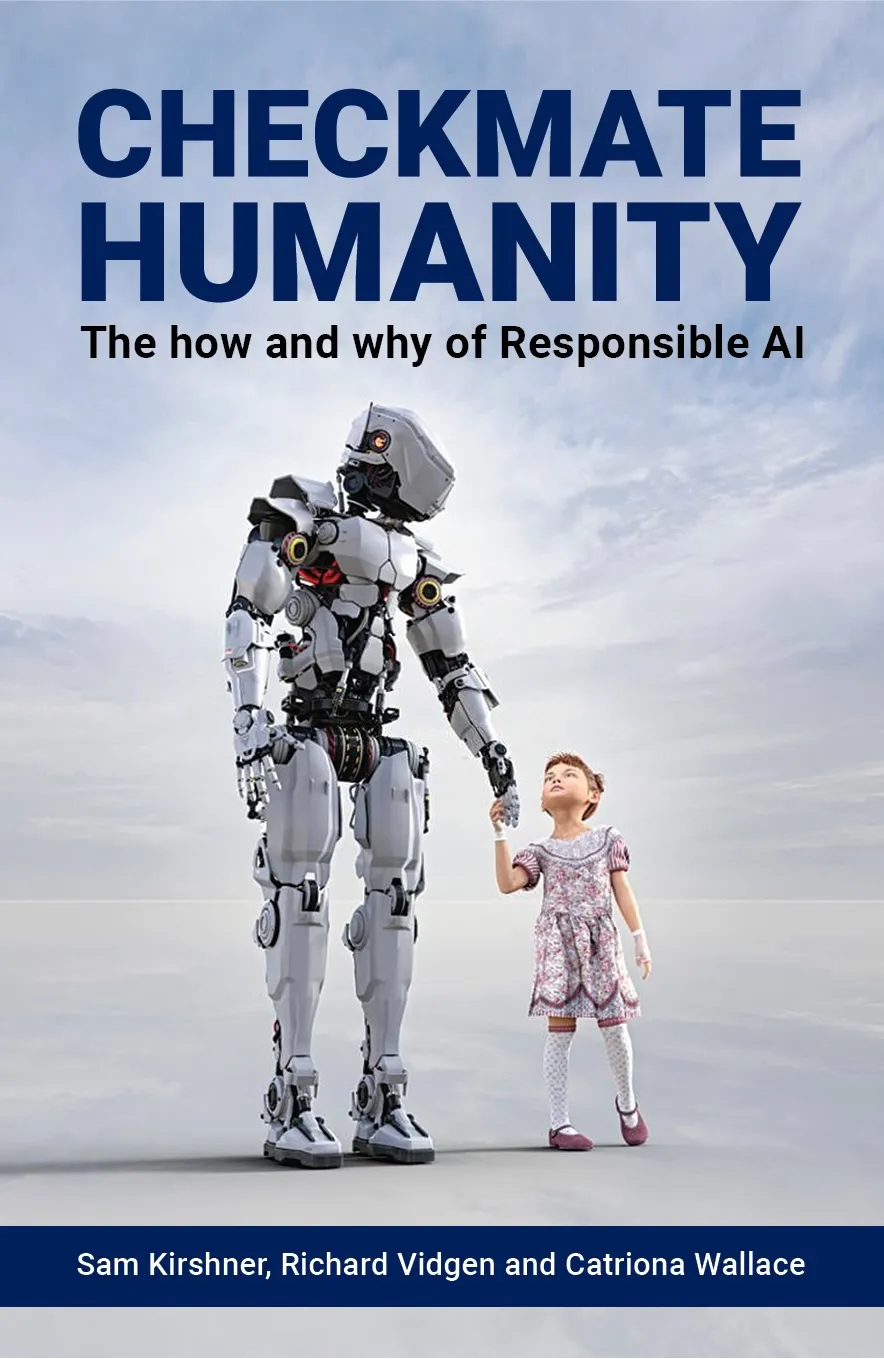
Checkmate Humanity: The how and why of responsible AI
AI is the fastest growing technology sector in the world, valued at US$59.67 billion in 2021 and is estimated to expand at a compound annual growth rate of 39.4 percent to reach US$422.37 billion by 2028. AI is changing the way individuals, organisations, governments and society work and live. But will AI be ethical and how responsible will it be? And what does this even mean?
Checkmate Humanity: the how and why of responsible AI sets out to answer these questions and maps the potential harms that AI may cause from individual harms right through to full existential risk. We introduce the world’s first taxonomy of AI harms and then offer solutions and recommendations so that we can build a Responsible AI future.
Co authors: Sam Kirshner, Richard Vidgen with Tiberio Caetano, Rumtin Sepasspour and Kimberlee Weatherall.
$39.95 inc GST

Catriona Wallace
Dr Catriona Wallace is a globally recognised authority in artificial intelligence, ethics, and leadership transformation. Named by the Australian Financial Review as Australia’s Most Influential Woman in Business and Entrepreneurship, and acknowledged as a pre-eminent scientist by the Royal Institution of Australia, she holds two PhDs and has founded multiple trailblazing companies. A former Shark on Shark Tank Australia and Adjunct Professor, Catriona is also the co-author of Checkmate Humanity and founder of the Responsible Metaverse Alliance. She advises governments and corporations worldwide on the ethical adoption of emerging technology.
REVIEWS FOR Checkmate Humanity: The how and why of responsible AI
Explore Checkmate Humanity: The how and why of responsible AI
AI is the fastest growing technology sector in the world, valued at US$59.67 billion in 2021 and is estimated to expand at a compound annual growth rate of 39.4 percent to reach US$422.37 billion by 2028. AI is changing the way individuals, organisations, governments and society work and live. But will AI be ethical and how responsible will it be? And what does this even mean? Checkmate Humanity: the how and why of responsible AI sets out to answer these…
CHAPTERS
Forewords by Louis Rosenberg and Ed Santow
There is a larger trend across AI technologies: they are being developed at increasingly faster rates while preparations for AI-related risks are not keeping up.
Introduction. AI in context
In investigating AI harms we do not seek to place the spotlight on organisations or AI technology indivudally, rather we approach the issue as an entanglement of organisations and AI.
How AI works
The ‘basics’ of AI and how it worksL algorithms, AI and machine learning, deep learning and more.
AI benefits and harms
Why does AI go wrong. the taxonomy of AI harms, the lack of visibility and accountability
The metaverse - the next ethical battlefield
Potential risks of the metaverse and what can be done to minimise harms
Existential risks of AI
The rise of powerful AI will either be the best or the worst thing ever to happen to humanity. Stephen Hawking. Exploring the risks
Ai development and deployment
The organisational perspective on Responsible AI staring with a model of the AI development and deployment process and then how AI applications are embedded in business processes.
Derisking automated decisions
Human and automated decision making systems fail in different ways so their governance needs to be designed to address these different modes of failure.
The Responsible AI index
What is the Responsible AI Index and how it can help address potential for AI harms
Regulation and governance of AI
How to regulate to limit, mitigate and remediate harms cause by using AI